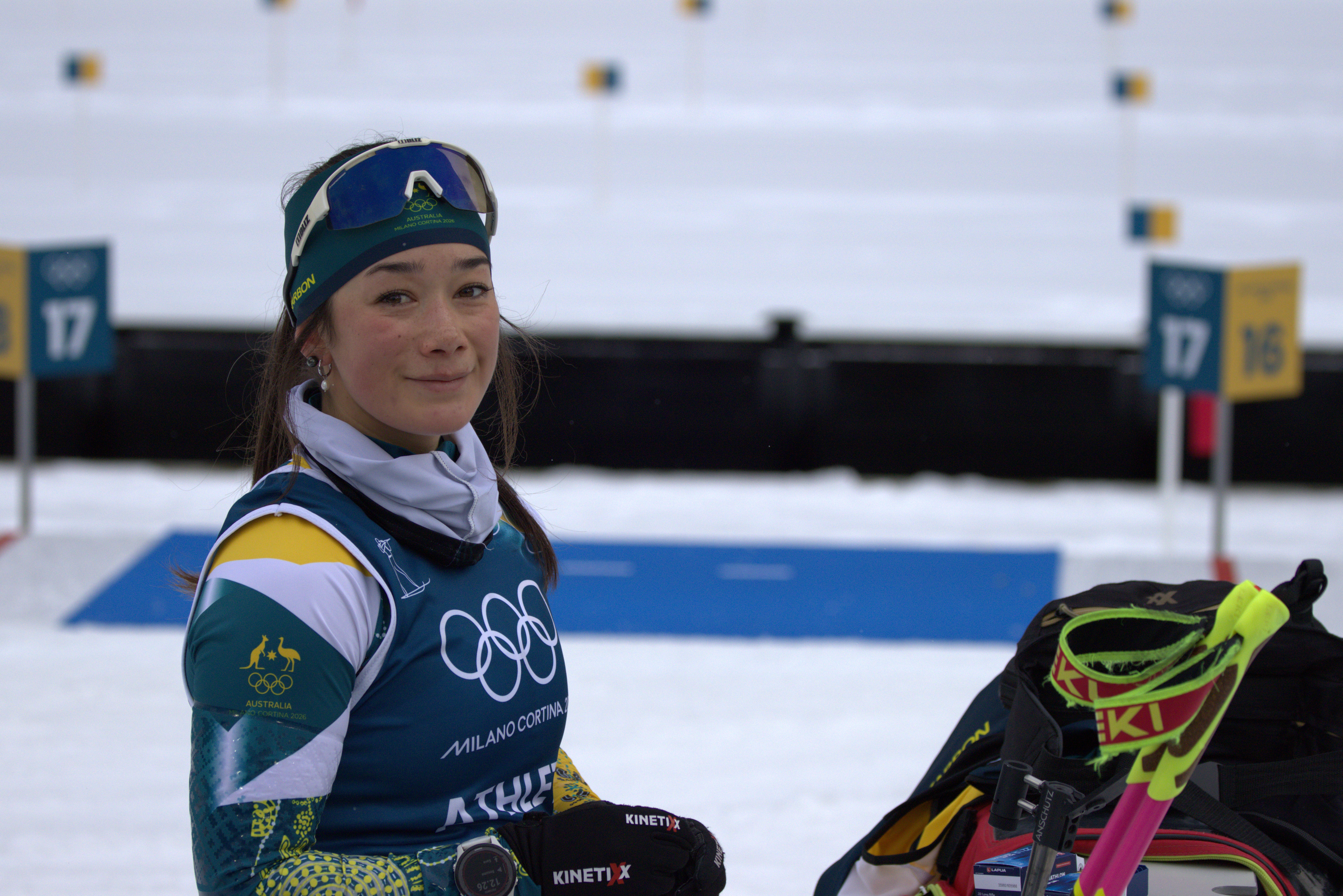
Darcie Morton made history by becoming the first Australian biathlete in more than a decade to compete at the Winter Olympics. In this interview she speaks about growing up in a biathlon family, spending months away from home, and the challenges of building a career in a sport dominated by European nations.

You grew up in a biathlon family,– your father competed at the Olympics and your sibling raced at World Cup level yet you initially chose table tennis. But recently you mentioned that the Youth Olympics was a major milestone for you. Following that experience, was it immediately clear that biathlon was your definite path, or did you still have doubts?
After Youth Olympics, I immediately knew I wanted to continue with biathlon. It was a very defining part of my life to choose between the two sports, as I was quite high level in both. But it ended up being that biathlon was my family sport, and I would be more outdoors in nature, which I really love, and the thrill of an endurance sport and precision of shooting really hooked me. Just having my family involved in the sport compared to table tennis, I really had no doubt after Youth Olympics that I wanted to continue.
The Olympics ended for you with the sprint. Looking back now, what stays with you the most — the performance itself, or the experience around it? And in hindsight, would you have done anything differently?
When you’re looking back at a race, I think you’re always thinking about what you could have done better and how you could have improved on it. So at first I was thinking I could have paced it better – I went out way too hard, and then really blew up in the last lap, and I should have gone out a bit slower on different parts of the track and paced myself. And then also on the shooting, I wish I had held a little bit longer on the last standing. I had those doubts and things I would have liked to do better in the race in that way. But when I look back on it now, it’s just amazing that my family was there at the finish line. And even my aunties and uncles from England and Australia and that they followed me all the way over here just to watch me. And no matter what my performance was, they were there to support me and I think that’s what I really took away the most, and what stayed with me the most.
Biathlon is still a very Europe-centred sport, with most World Cups and major events held far from Australia. How challenging is it to compete week after week so far from home, and do you ever get the chance to return to Australia during the season?
It was really difficult for me to be overseas for so long. Over the last 17 months I’ve been in Australia for one month, and so even though I had a really good base in Norway, it was always quite difficult to stay away from home, and I didn’t get a chance to return to Australia. So I practically went from last season, had a bit of a holiday in Greenland, and then I went home for a month, and then I practically came straight back to Norway to start training again for their summer period. Because it’s so far away and so expensive, I didn’t get a chance to travel back. So I think that is definitely difficult, because most teams, when they have camps, they have a few weeks on and then they go home for a week, and I think that really helps your mind settle. But I wasn’t able to do that. So I guess finding that biathlon family that we have in the sport was really crucial to that. Also making a team in Norway, and having my brother and my father support me over there as well, really helped with that.
Ahead of the qualification season, you launched a crowdfunding campaign that exceeded expectations and allowed you to join a Norwegian team. How did that change your daily training environment, and what were the biggest differences compared to your previous opportunities?
The crowdfunding and the ASF (Australian Sports Foundation), and the people supporting me like the small businesses in Far East Gippsland where I live that donated to that fundraising campaign – I think it just took stress off my shoulders. I am usually very stressed with finances, and I have to book all my accommodation and travel and everything myself, which a lot of athletes don’t have to do, and just having that little bit aside and that team that’s already set, really helped bring the stress down. I still was very cautious of it, and I stayed with a friend which made it a little bit cheaper to rent. I definitely still tried to save the money, but, yeah, it was a massive help. And honestly, just a mental stress off my shoulders.
After your Olympic debut, what are your sporting ambitions for the next Olympic cycle? Are you aiming for regular World Cup starts, specific results, or building something longer-term within Australian biathlon?
This Olympic cycle has been quite stressful, but I did achieve my biggest goal of just getting there. It’s very ambitious to look to the next cycle, and I honestly haven’t thought about it so much, but I have to return to Australia to do my Army Reserve training. So at the moment, because I’ve been away for so long, that’s the first priority to complete that and continue training as best I can in Australia through that. But looking any further than that, I haven’t actually thought through it yet.
You became the first Australian biathlete in over a decade to compete at the Olympics. Do you feel like a pioneer, or does that label add pressure? And realistically, what needs to change for Australia to become a consistent presence in the sport?
I think it was a pretty big milestone for an Australian biathlete to qualify after so long. And I don’t necessarily feel like a pioneer, but it did add a little bit of pressure.
I think the most difficult part of being in the Australian team is that you don’t have a big team around you or that culture of biathlon, so to be able to work more with other nations at a higher level would be quite good. We do have some partnerships through IBU for the juniors, but not so much for elite athletes on World Cup. So that would be quite a big help for Australia, and obviously we need to build up from the bottom as well, but I feel like we need to support our high level athletes a lot more because they’re the ones that are able to get more points on World Cup and IBU Cup. So I think it’s a balance between developing from the bottom and also building on the top of what you’ve already got.

Alongside your sporting career, you completed a medical science degree at the Australian National University and plan to pursue a master’s degree in physiotherapy. How difficult is it to balance elite sport with academic life, and when you look five years ahead, what would success mean to you?
It was really difficult for me when I was studying full time. I was also working full time in multiple jobs such as coaching and waitressing and different things. So I found it really difficult, but it was also very fulfilling to be that busy and be able to accomplish so many things and have a degree under my belt already. But when you’re racing against the best in the world, you really have to put everything in and just train. It’s very difficult, I think, to do both and succeed in both at a high level. And I have very high expectations for myself, so when I do something, I need to do it right and put all my effort into it. So it was difficult, in that way, to balance the two. But I think at that time, I succeeded in doing that.
Looking ahead five years, I think just being able to see that I enjoy what I do in my life, and that I’m proud of my results and I’m proud of my accomplishments. I think that would be the most important thing for me.
Thanks to Darcie Morton and the Australian Olympic Committee for their time and cooperation.
Leave a Reply