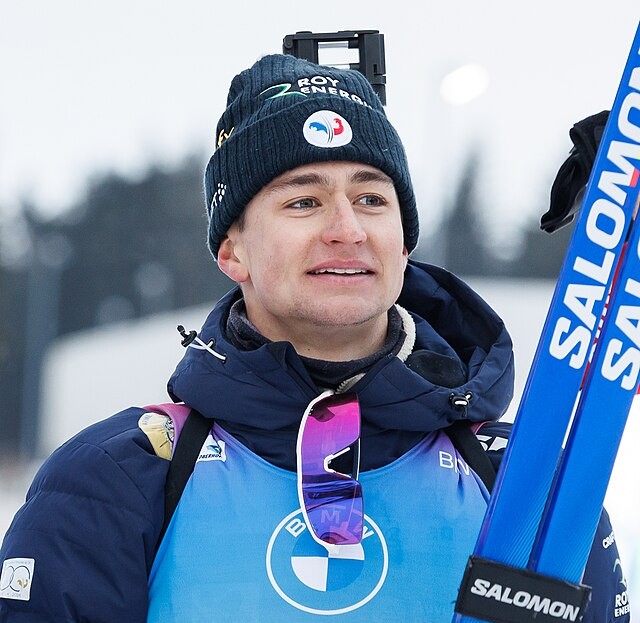
A season that began with the shock of Johan-Olav Botn, continued with the rise of Tommaso Giacomel, and ended with the cold-blooded triumph of Éric Perrot – all while Sturla Holm Lægreid reached a new level following the Olympics.
The Season in Numbers
- 25 individual races (21 World Cup + 4 Olympic events).
- 9 different winners, with Sturla Holm Lægreid crowned as “king” after 5 consecutive victories.
- 17 podium finishers from 6 different nations.
- Norwegian Dominance: There were only two podiums throughout the entire season that did not feature a Norwegian athlete.
The season can be divided into several distinct phases, as performances fluctuated significantly throughout the year.
1. The Botn Explosion
During the opening weekend, Botn shocked the field by winning the first two races in Sweden and even securing a podium finish in the third individual race. At that point, it initially appeared that Samuelsson and Fillon Maillet would be the Norwegian’s biggest challengers. However, this changed by the second weekend as both the Swede and the Frenchman struggled. Meanwhile, Giacomel and Perrot each secured two podium finishes, establishing themselves as Botn’s primary rivals in the World Cup. By the Christmas break in France, it was hard to imagine the overall winner coming from anyone other than Botn, Giacomel, or Perrot.
2. The Italian-French Duel
The situation shifted dramatically in Oberhof. Botn was unable to compete due to illness, an opportunity Giacomel exploited perfectly by winning both races to take the lead in the standings. The Norwegian did not return for Ruhpolding either, effectively ending his chances for the overall title. The Italian started that weekend with a lead of over 50 points over Botn and over 80 points over Perrot. As the two leaders earned identical points over the weekend, the gap between them remained unchanged, while Botn’s deficit grew to over 170 points.
3. Perrot’s Turnaround
he final round before the Olympics brought a major shift in dynamics. Perrot became incredibly convincing, winning both races while Giacomel’s form began to slide. Perrot overtook the lead in the standings, heading into the Olympic break with a lead of more than 30 points over the Frenchman. Botn returned for the weekend in the Czech Republic but recorded his weakest results of the season. Samuelsson, sitting in 3rd place, also saw his deficit grow significantly, effectively ending his title hopes.
4. Four Different Winners, Lægreid’s Feat, and Giacomel’s Drama
At the Olympics, Botn won the Individual race—a result few expected given his previous performance in the Czech Republic. Perrot’s podium in the first race was no surprise, but Lægreid’s 3rd place certainly was, as it marked his first top-3 finish of the season. In the Sprint, Fillon Maillet delivered a dominant performance, winning by a surprisingly large margin. This was another unexpected turn, as the Frenchman had not stood on the podium since the very first weekend. Giacomel’s shooting completely collapsed, failing even to reach the top 20 in the Sprint.
The Pursuit brought a career-defining moment for Ponsiluoma, who became Olympic champion. Behind him, Lægreid secured his third individual medal of the games; it was evident the Norwegian had prepared perfectly, showing significantly improved skiing times and results. During the Mass Start, it appeared Giacomel was in contention for a medal, but while leading the race, he fell ill and was unable to finish. It was later revealed he suffered from a heart condition similar to the one previously discovered in Tandrevold, and he underwent surgery. Dale performed perfectly that day—the only athlete to do so—and deservedly became Olympic champion.
5. Lægreid’s Streak and Perrot’s Success
Following Giacomel’s surgery, it was confirmed he would not compete again this season, making Perrot’s significant lead almost insurmountable. In Finland, Perrot essentially decided the title by securing a 1st and a 2nd place finish, extending his lead over Samuelsson to more than 260 points. Meanwhile, Lægreid continued his individual podium streak, reaching six consecutive races. The remainder of the season was largely defined by the Norwegian, who swept every race in Estonia and the first two last week in Oslo. Jacquelin also found his form, reaching the podium four times in the final six races. The final race was won by Botn, bringing the season full circle as he won both the first and last events. Perrot maintained a stable performance through the final races, leaving no doubt as to who would win the overall title. The best U23 athlete was clearly Isak Frey, who could secure even more victories next year if his development continues.
Winter Sports Hub Awards:
Every weekend, I awarded the “Athlete of the Week,” as well as “Positive and Negative Surprises.” Here is the summary. Note that these were not divided by gender; I chose only one winner per weekend from across the entire field.
| Category | Athletes |
| Athlete of the Week (2x) | Éric Perrot, Tommaso Giacomel |
| Athlete of the Week (1x) | Johan-Olav Botn, Sturla Holm Lægreid |
| Positive Surprise of the Season | Johannes Dale (from IBU Cup to podium), the Estonian relay’s Top 5 finish, and the German Pfund’s performance in the Czech Republic. |
| Negative Surprise of the Season | Jacquelin’s slump in Oberhof and Samuelsson’s struggles in the Czech Republic. |
Shooting and Skiing Statistics
At the end of the season, it is worth examining the best shooters (minimum 100 shots taken). Among them, Lægreid and the tragically deceased Bakken were the best with a 92% accuracy rate, followed by the Romanian Shamaev at 89%. In terms of skiing performance, Dale, Ponsiluoma, Giacomel, Botn, and Samuelsson were the strongest.
The shift in form is also visible through the official IBU performance trend graphs:

His graph shows that as we progressed from the mid-season, his skiing time and standing shooting steadily improved, leading to his explosive late-season results.

His diagram shows a strong period in late December and early January, followed by a decline in shooting accuracy leading up to the Olympics.

His chart displays impressive consistency; the lines do not fluctuate drastically, and this stability is exactly what earned him the overall title.
Retirements
As is common in an Olympic year, many athletes are ending their careers. In the men’s field, Jakov Fak, Simon Eder, Vladimir Iliev, Antonin Guigonnat, and Johannes Kühn have all retired. The two biggest names are undoubtedly Fak and Eder. (UPDATE: Last year, Jakov Fak said this would be his final season, but in an interview a few weeks ago, he said he wasn’t sure he wouldn’t continue.)
Jakov Fak:
- Olympic Silver and Bronze
- 5 World Championship medals (2 gold, 1 silver, 2 bronze)
- 9 individual World Cup wins
- Over 400 WC starts
Simon Eder
- 2 Olympic Silver medals
- 5 World Championship medals (2 Silver, 3 Bronze)
- 3 individual World Cup wins
- Over 500 WC starts
Predictions and the Future
In my pre-season preview, I attempted to predict the outcome based on early-season results and other factors. I wrote: “Taking all circumstances into account, Éric Perrot currently appears to be the leading contender for the overall title, as Lægreid is likely to focus primarily on the Olympics following his previous overall victory. The question remains whether the improving Germans, Samuelsson, or perhaps another emerging Norwegian can challenge him.“
This prediction proved accurate regarding the overall title and Lægreid’s trajectory. However, the Germans’ pre-season form was misleading, as none were close to a top-3 overall finish by the end. The “new Norwegian” (Botn) could only momentarily scare the French and Italian leaders.
Looking ahead to next season, many questions remain: Can Botn maintain his form for a full year? Can Frey take the next step? Can Giacomel return? Will Perrot remain equally motivated? We will only have the answers in many months, but that is exactly why it will be worth watching when the races return in late November.
The Biathlon World Cup returns on November 26th.
Leave a Reply